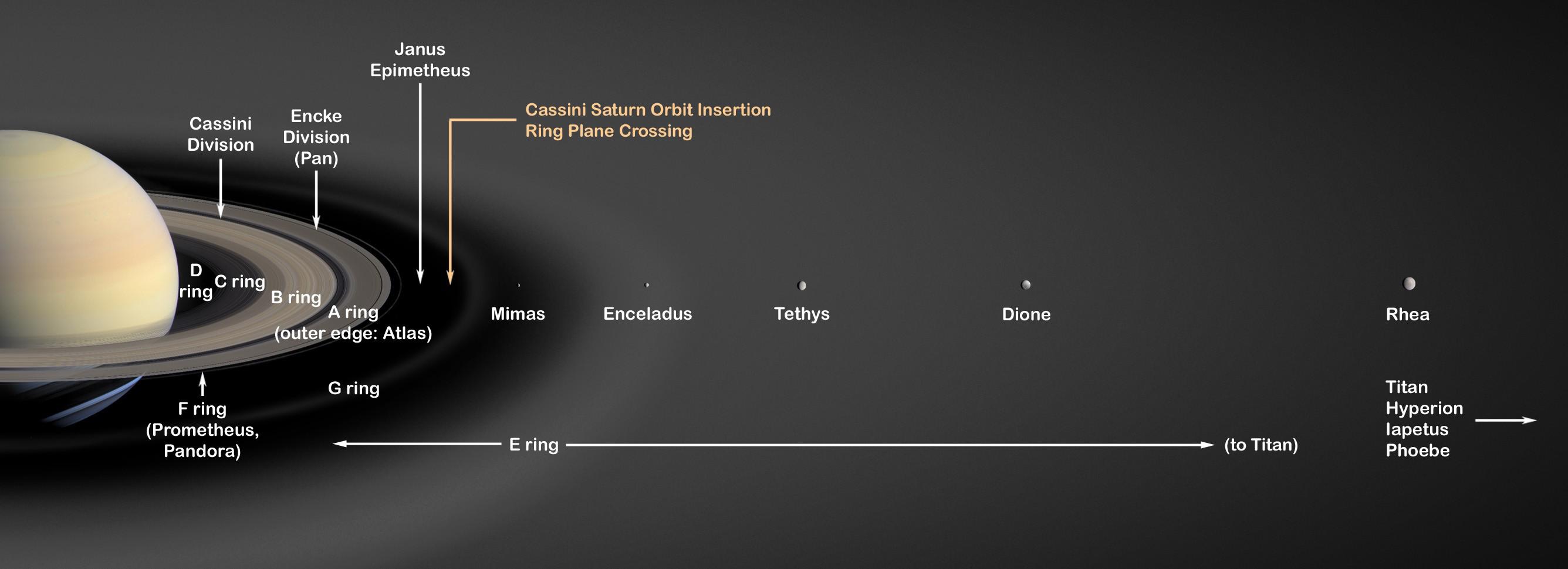
Saturn has 83 known moons, 53 of which have formal names. It is estimated that there are another 100±30 outer
irregular moons larger than 3 km (2 mi) in diameter. In addition, there is evidence of dozens to hundreds of
moonlets with diameters of 40–500 meters in Saturn's rings, which are not considered to be true moons. Titan,
the largest moon, comprises more than 90% of the mass in orbit around Saturn, including the rings. Saturn's
second-largest moon, Rhea, may have a tenuous ring system of its own, along with a tenuous atmosphere.
Many of the other moons are small: 34 are less than 10 km in diameter and another 14 between 10 and 50 km in
diameter. Traditionally, most of Saturn's moons have been named after Titans of Greek mythology. Titan is the
only satellite in the Solar System with a major atmosphere, in which a complex organic chemistry occurs. It is
the only satellite with hydrocarbon lakes.
On 6 June 2013, scientists at the IAA-CSIC reported the detection of polycyclic aromatic hydrocarbons in the
upper atmosphere of Titan, a possible precursor for life. On 23 June 2014, NASA claimed to have strong evidence
that nitrogen in the atmosphere of Titan came from materials in the Oort cloud, associated with comets, and not
from the materials that formed Saturn in earlier times.
Saturn's moon Enceladus, which seems similar in chemical makeup to comets,[108] has often been regarded as a
potential habitat for microbial life. Evidence of this possibility includes the satellite's salt-rich particles
having an "ocean-like" composition that indicates most of Enceladus's expelled ice comes from the evaporation of
liquid salt water. A 2015 flyby by Cassini through a plume on Enceladus found most of the ingredients to sustain
life forms that live by methanogenesis.
In April 2014, NASA scientists reported the possible beginning of a new moon within the A Ring, which was imaged
by Cassini on 15 April 2013.
Planetary Rings
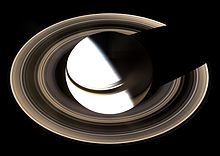
Saturn is probably best known for the system of planetary rings that makes it visually unique. The rings
extend from 6,630 to 120,700 kilometers (4,120 to 75,000 mi) outward from Saturn's equator and average
approximately 20 meters (66 ft) in thickness. They are composed predominantly of water ice, with trace
amounts of tholin impurities and a peppered coating of approximately 7% amorphous carbon. The particles that
make up the rings range in size from specks of dust up to 10 m. While the other gas giants also have ring
systems, Saturn's is the largest and most visible.
There are two main hypotheses regarding the origin of the rings. One hypothesis is that the rings are
remnants of a destroyed moon of Saturn, for which a research team at MIT has proposed the name "Chrysalis".
The second hypothesis is that the rings are left over from the original nebular material from which Saturn
was formed. Some ice in the E ring comes from the moon Enceladus's geysers. The water abundance of the rings
varies radially, with the outermost ring A being the most pure in ice water. This abundance variance may be
explained by meteor bombardment.
Beyond the main rings, at a distance of 12 million km from the planet is the sparse Phoebe ring. It is
tilted at an angle of 27° to the other rings and, like Phoebe, orbits in retrograde fashion.
Some of the moons of Saturn, including Pandora and Prometheus, act as shepherd moons to confine the rings
and prevent them from spreading out. Pan and Atlas cause weak, linear density waves in Saturn's rings that
have yielded more reliable calculations of their masses.

 HOME
HOME
 PHYSICAL
 ORBIT&
 EXPLORATION
 REFERENCE