
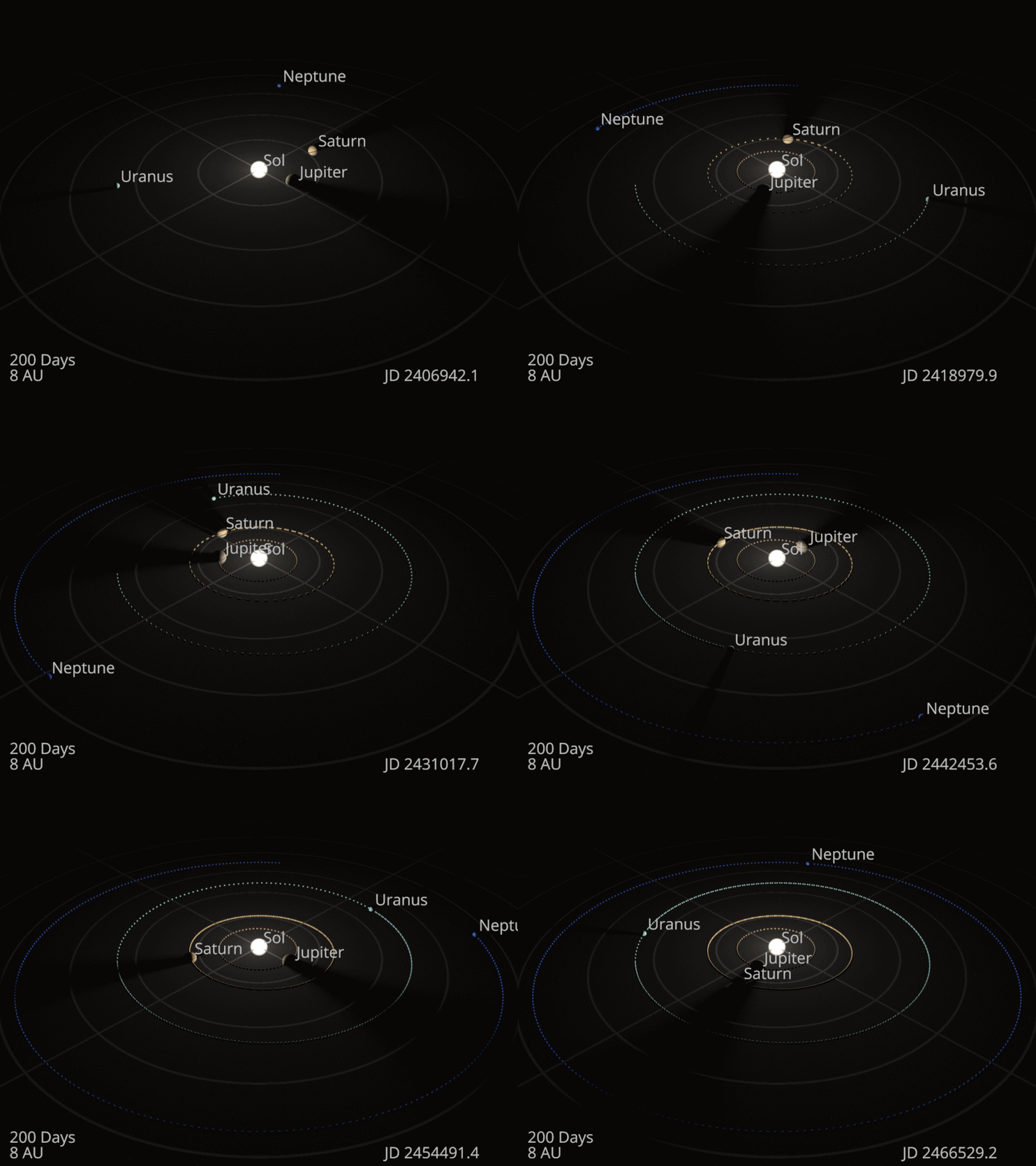
The average distance between Saturn and the Sun is over 1.4 billion kilometers (9 AU). With an average orbital
speed of 9.68 km/s, it takes Saturn 10,759 Earth days (or about 29+1⁄2 years) to finish one revolution around
the Sun. As a consequence, it forms a near 5:2 mean-motion resonance with Jupiter. The elliptical orbit of
Saturn is inclined 2.48° relative to the orbital plane of the Earth. The perihelion and aphelion distances are,
respectively, 9.195 and 9.957 AU, on average.[11][84] The visible features on Saturn rotate at different rates
depending on latitude, and multiple rotation periods have been assigned to various regions (as in Jupiter's
case).
Astronomers use three different systems for specifying the rotation rate of Saturn. System I has a period of 10h
14m 00s (844.3°/d) and encompasses the Equatorial Zone, the South Equatorial Belt, and the North Equatorial
Belt. The polar regions are considered to have rotation rates similar to System I. All other Saturnian
latitudes, excluding the north and south polar regions, are indicated as System II and have been assigned a
rotation period of 10h 38m 25.4s (810.76°/d). System III refers to Saturn's internal rotation rate. Based on
radio emissions from the planet detected by Voyager 1 and Voyager 2, System III has a rotation period of 10h 39m
22.4s (810.8°/d). System III has largely superseded System II.
A precise value for the rotation period of the interior remains elusive. While approaching Saturn in 2004,
Cassini found that the radio rotation period of Saturn had increased appreciably, to approximately 10h 45m 45s ±
36s.[87][88] An estimate of Saturn's rotation (as an indicated rotation rate for Saturn as a whole) based on a
compilation of various measurements from the Cassini, Voyager and Pioneer probes is 10h 32m 35s. Studies of the
planet's C Ring yield a rotation period of 10h 33m 38s + 1m 52s
− 1m 19s.
In March 2007, it was found that the variation of radio emissions from the planet did not match Saturn's
rotation rate. This variance may be caused by geyser activity on Saturn's moon Enceladus. The water vapor
emitted into Saturn's orbit by this activity becomes charged and creates a drag upon Saturn's magnetic field,
slowing its rotation slightly relative to the rotation of the planet.
An apparent oddity for Saturn is that it does not have any known trojan asteroids. These are minor planets that
orbit the Sun at the stable Lagrangian points, designated L4 and L5, located at 60° angles to the planet along
its orbit. Trojan asteroids have been discovered for Mars, Jupiter, Uranus, and Neptune. Orbital resonance
mechanisms, including secular resonance, are believed to be the cause of the missing Saturnian trojans.
 HOME
HOME
 PHYSICAL
 NATURAL
 EXPLORATION
 REFERENCE